
Cryptocurrency markets are rarely static, and the price of Hedera Hashgraph’s native token, HBAR, is no exception. As one of the most technically ambitious distributed ledger projects, Hedera has generated considerable attention among developers, enterprises, and speculative investors alike. Monitoring HBAR’s live value, market capitalization, and chart movements unveils intricate stories about growth, trust, adoption, and future potential within the decentralized economy.
What Drives the Live Hedera Price?
The value of HBAR is influenced by a complex interplay of crypto market fundamentals, ecosystem milestones, and macroeconomic forces. Like other tokens, HBAR trades on multiple global exchanges, which react to shifting tides of sentiment and liquidity. However, Hedera’s unique consensus model and corporate governance council distinguish it from many blockchain competitors.
Supply, Demand, and Hedera’s Tokenomics
Several supply-related factors set the rhythm for HBAR’s price movement:
- Total and Circulating Supply: Hedera maintains a maximum supply of 50 billion HBAR. Of this, only a portion is in circulation at any given time, with the rest released via scheduled allocations, grants, and network incentives.
- Staking and Node Rewards: HBAR powers network security and utility. As users stake tokens to validators (nodes), rewards help keep HBAR off exchanges, influencing short-term liquidity.
- Enterprise Adoption: Some of the world’s top companies, including Google, IBM, and Boeing, participate in Hedera’s governance. When new enterprise applications are announced or projects move into production, investor optimism can spike.
External Market and Macro Trends
Cryptocurrency valuations are famously sensitive to global economic shifts and regulatory discussions. Bitcoin, as the crypto benchmark, often drives broad sector upswings—or downturns—that ripple through assets like HBAR.
Events such as central bank policy shifts, institutional crypto adoption, or high-profile security incidents can influence HBAR’s price independently of Hedera’s technical roadmap.
“HBAR’s value proposition is equally defined by its enterprise-grade architecture and its ability to withstand industry volatility,” notes a senior blockchain analyst at a leading fintech firm. “When blue-chip partners deploy real-world solutions, the market often responds swiftly.”
Market Cap Insights: HBAR’s Position Among Crypto Assets
Market capitalization provides a snapshot of HBAR’s standing within the digital asset ecosystem. Calculated as the product of live price and circulating supply, Hedera’s market cap has climbed into the ranks of notable altcoins—often oscillating among the top 40 by capitalization.
Historical Trends and Volatility
Since its mainnet launch, HBAR has experienced periods of dramatic appreciation and correction:
- 2021 Bull Market: Driven by record venture funding and DeFi/NFT excitement, HBAR’s price saw double- or triple-digit percentage increases from its 2020 origin.
- Corrections: Crypto bear markets have delivered sharp retracements, but Hedera’s differentiated technology has supported subsequent recoveries.
Market Cap Versus Utility
Unlike traditional companies, a crypto project’s market cap doesn’t always reflect underlying usage. However, as Hedera’s transactional throughput (often millions of transactions daily) has grown, bullish cases often hinge on rising demand for HBAR-powered services—especially for tokenized assets, supply chains, and payments.
HBAR Price Chart Analysis: Reading Patterns and Signals
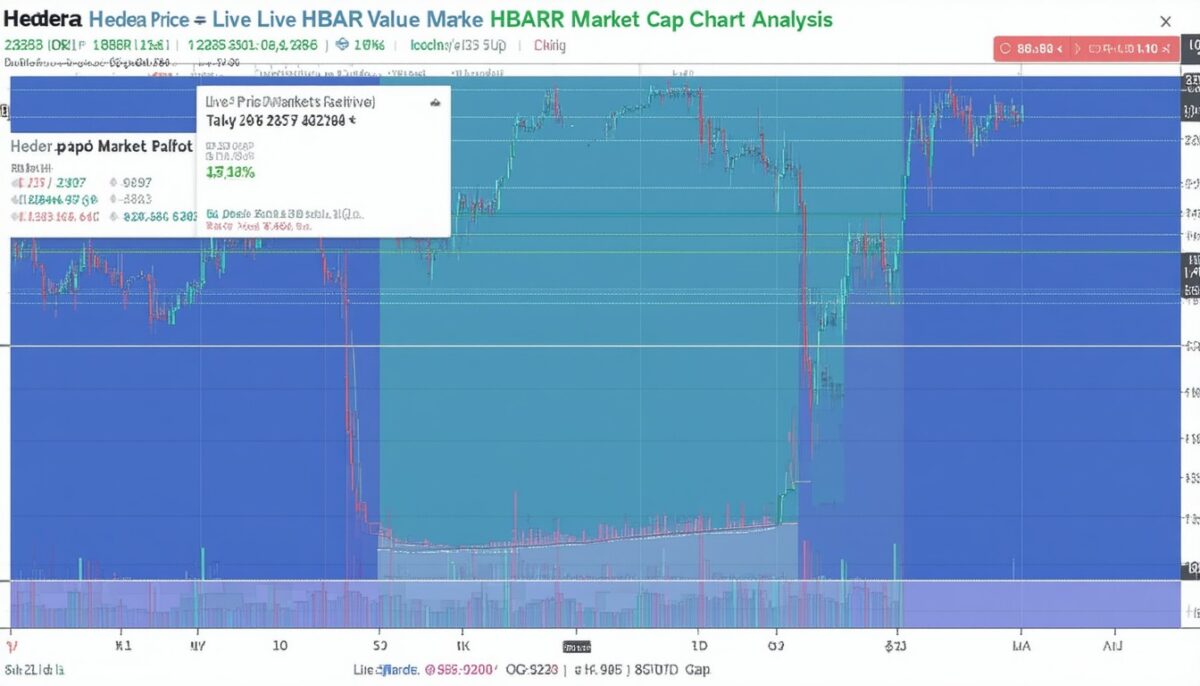
For traders and long-term holders, chart analysis is a critical tool. Live and historical HBAR/USDT charts, available on major exchanges, provide real-time insight into market sentiment and volatility.
Technical Indicators and Trendlines
Analysts typically watch for:
- Support and Resistance Zones: Past price levels where HBAR has consolidated or reversed can act as future “footholds” or “ceilings.”
- Moving Averages: Short-term (10- or 20-day) and longer-term (50- or 200-day) moving averages help gauge the overall trend.
- Volume Spikes: Unusual trading volume often hints at future volatility or the aftermath of major news events.
Notable Chart Events
In practice, Hedera’s price has often responded sharply to news of network upgrades (such as EVM compatibility launches), partnership announcements, or wider market swings. Crypto-focused publications regularly cite HBAR’s performance as an indicator of broader Layer 1 sentiment.
Beyond Price: The Broader Context for Hedera
While price analysis dominates headlines, understanding HBAR’s value means looking at the broader Hedera ecosystem.
Enterprise Use Cases and Network Activity
Hedera is designed to support high-volume, low-latency transactions—making it attractive for real-world business applications. Industries including digital identity, supply chain management, and tokenization of real-world assets are actively piloting or deploying Hedera-backed projects.
For example, Avery Dennison’s atma.io platform uses Hedera to power item-level traceability for billions of products, underscoring the blockchain’s enterprise reach. As more organizations tap into Hedera’s capabilities, network usage metrics—like transaction count and active accounts—become leading (and often price-influencing) indicators.
Governance, Decentralization, and Market Confidence
Decentralized governance is another HBAR differentiator. By entrusting network direction to a council of global organizations, Hedera aims to minimize risk and reassure institutional users—a point regularly mentioned in analyst briefs and media coverage.
Concluding Summary: Key Takeaways on HBAR’s Price and Future
HBAR’s price is continually shaped by a mix of real-world adoption, institutional partnerships, advanced technical features, and broader macro trends. Chart movements tell part of the story, but deeper analysis requires understanding the ongoing evolution of Hedera’s ecosystem and the trust placed in its governance.
Going forward, prospective traders and investors should monitor not only the live HBAR price and chart signals but also network milestones, enterprise integrations, and the shifting landscape of global digital asset regulation.
FAQs
What is the maximum supply of HBAR, and how does it affect price?
HBAR has a hard cap of 50 billion tokens, with only a portion circulating currently. Gradual token releases and incentives impact liquidity and can influence market price.
Why does HBAR’s price react to partnership announcements?
High-profile collaborations often signal confidence in Hedera’s technology and future usage, prompting speculative and strategic buying.
How can I view live HBAR price and charts?
Major cryptocurrency exchanges and financial data platforms provide real-time pricing, live charting, and historical HBAR performance analytics.
What role does staking play in the HBAR ecosystem?
Staking helps secure the network and allows HBAR holders to earn rewards, impacting overall token availability and, potentially, price trends.
Is Hedera’s market cap a reliable indicator of its utility or value?
Market cap offers a relative measure of standing among cryptocurrencies but doesn’t always correlate directly with platform usage or adoption.
What factors could impact HBAR’s price in the long term?
Ongoing network upgrades, regulatory developments, enterprise adoption, and overall crypto sector health will all contribute to shaping HBAR’s long-term value proposition.